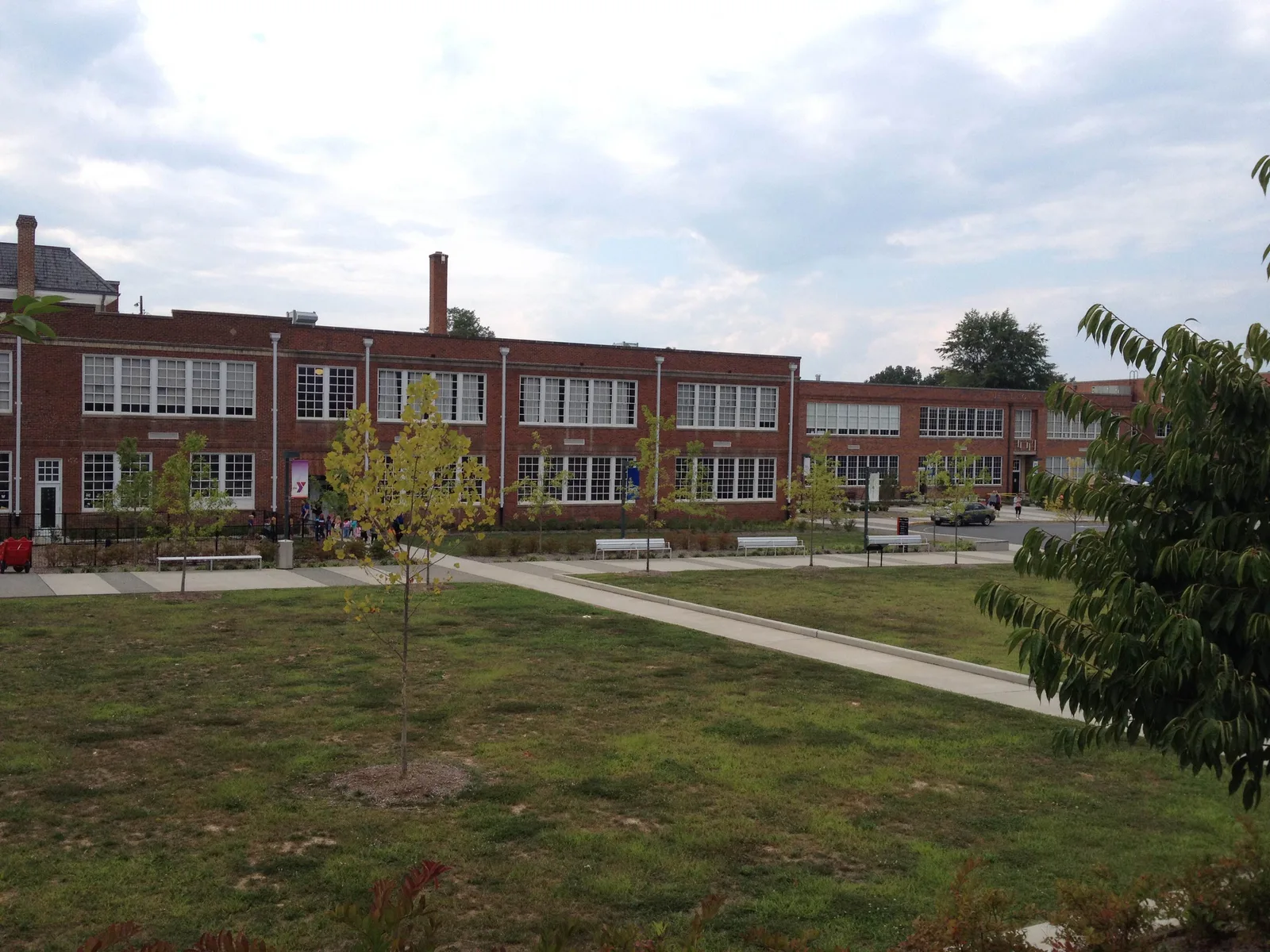
Charlottesville was founded in 1762 as the Albemarle County seat. The city has 63 National Register listings, from Oak Lawn (1973) to the Downtown Mall (2024).
Last checked Oct. 18, 2026. Facts on this page come from the City of Charlottesville’s About Charlottesville and Historic Districts and Design Review pages, the Virginia Department of Historic Resources’ register entries for Charlottesville, city releases from July 2021 and the Albemarle Charlottesville Historical Society.
Charlottesville was founded in 1762 as the seat of Albemarle County, and Court Square, where the county courthouse still stands, has been a regional political center ever since, according to the Virginia Department of Historic Resources (DHR). Today the city is, in its own words, “autonomous and entirely independent of any county,” at the headwaters of the Rivanna River at the foot of the Blue Ridge.
Visit and research
- Albemarle Charlottesville Historical Society: 200 Second St. NE; free; lobby exhibits and research library 8 a.m. to 4 p.m. weekdays, 10 a.m. to 2 p.m. Saturdays; walking tours on Saturdays
- Jefferson School African American Heritage Center: Jefferson School City Center, Fourth Street NW; 434-260-8720; check its site for hours
- City preservation staff: 434-970-3130
How the city grew
The DHR record for the courthouse district describes a town shaped by the county court, Thomas Jefferson and the university, with a classic late-19th-century main street. The railroad arrived in 1850, when the Virginia Central linked Charlottesville with Richmond, and the city’s own transit history notes that more than 400 enslaved people made up the construction crew. The Chesapeake and Ohio line followed around 1868 and the Southern in 1894; where they crossed at Union Station, the tracks split the city into quarters that shaped its neighborhoods. Horse-drawn streetcars began in 1887 and electric streetcars in 1895.
Main Street became the Downtown Mall in two phases from 1976 to 1980, to a design by landscape architect Lawrence Halprin. DHR calls it his only surviving work in Virginia, and it became its own National Register historic district in 2024.
Jefferson School, opened on its site in 1894 as a graded school for Black children, became the center of the city’s African American community. In 1958 the NAACP sued on behalf of Jefferson students, leading to the court order that desegregated Charlottesville’s schools, DHR says. The building now houses the Jefferson School African American Heritage Center and the Carver Recreation Center.
Historic districts
The city protects eight local Architectural Design Control districts, where the Board of Architectural Review must approve exterior changes: Downtown, North Downtown, Ridge Street, West Main Street, The Corner, Wertland Street, Oakhurst-Gildersleeve and Rugby Road-University Circle-Venable. Several are also on the National Register.
National Register listings in the city
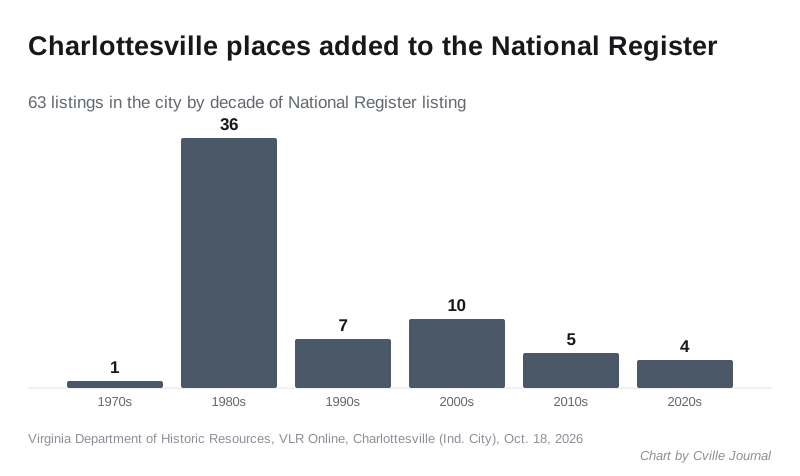
DHR lists these properties and districts in the city with the year each was added to the National Register of Historic Places. Most were added in 1982-84, many through the Charlottesville Multiple Resource Area nomination. University of Virginia landmarks such as the Rotunda are filed under Albemarle County and are not included.
| Property or district | National Register |
|---|---|
| Oak Lawn | 1973 |
| Anderson Brothers Building | 1982 |
| Barringer Mansion | 1982 |
| Belmont | 1982 |
| Carter-Gilmer House | 1982 |
| Charlottesville and Albemarle County Courthouse Historic District | 1982 |
| Delevan Baptist Church | 1982 |
| Enderly | 1982 |
| Four Acres | 1982 |
| Gardner-Mays Cottage | 1982 |
| Lewis Farm (The Farm) | 1982 |
| Locust Grove | 1982 |
| Patton Mansion | 1982 |
| Paxton Place | 1982 |
| Peyton-Ellington Building | 1982 |
| Ridge Street Historic District | 1982 |
| White Cross, Huntley Hall | 1982 |
| Woolen Mills Chapel | 1982 |
| Wyndhurst | 1982 |
| Young Building | 1982 |
| Benjamin Tonsler House | 1983 |
| Hotel Gleason (Albemarle Hotel/Imperial Café) | 1983 |
| House at Pireus | 1983 |
| King Lumber Company Warehouse | 1983 |
| King-Runkle House | 1983 |
| McConnell-Neve House | 1983 |
| Pireus Store | 1983 |
| Robert L. Updike House | 1983 |
| Rose Cottage (Peyton House) | 1983 |
| Turner-LaRowe House | 1983 |
| Dabney-Thompson House | 1984 |
| Hard Bargain | 1984 |
| Morea | 1984 |
| Stonefield | 1984 |
| Timberlake-Branham House | 1984 |
| Wertland Street Historic District | 1985 |
| John Vowles House | 1989 |
| Ficklin-Crawford Cottage | 1992 |
| Mount Zion Baptist Church | 1992 |
| Robert Edward Lee Sculpture (statue removed 2021) | 1997 |
| Thomas Jonathan Jackson Sculpture (statue removed 2021) | 1997 |
| “Their First View of the Pacific” (Lewis and Clark sculpture, removed 2021) | 1997 |
| Judge William J. Robertson House | 1999 |
| Marshall-Rucker-Smith House | 1999 |
| Abell-Gleason House | 2001 |
| Montebello | 2003 |
| Sunnyside | 2003 |
| Recoleta | 2004 |
| Charles B. Holt House | 2006 |
| Jefferson School | 2006 |
| Preston Court Apartments | 2007 |
| Martha Jefferson Historic District | 2008 |
| Oakhurst-Gildersleeve Neighborhood Historic District | 2009 |
| William H. McGuffey Primary School | 2009 |
| Daughters of Zion Cemetery | 2010 |
| Charlottesville Coca-Cola Bottling Works | 2013 |
| Foster Site | 2016 |
| West Main Street Historic District | 2017 |
| North Belmont Neighborhood Historic District | 2018 |
| Charlottesville Downtown Mall Historic District | 2024 |
| James Minor House | 2025 |
| Thomas Jefferson Inn | 2025 |
| Thomas and Alena Hammond House | 2026 |
Monuments removed in 2021
The register still includes the three statues Paul Goodloe McIntire gave the city, listed in 1997. City Council voted unanimously in June 2021 to remove the Robert E. Lee and Thomas “Stonewall” Jackson statues, and the city took them down on July 10, 2021. That afternoon, after an emergency meeting, the council voted 5-0 to remove the Lewis, Clark and Sacagawea statue as well.
Cemeteries and markers
Daughters of Zion Cemetery, listed in 2010, was established in 1873 by an African American mutual aid society as a burial ground for Black residents when the city’s Oakwood Cemetery was segregated, DHR says. The city’s downtown walking tour map (PDF) points out historic buildings around the Downtown Mall and Court Square.
What this means for you
- Own a house in a historic district? Exterior work needs Board of Architectural Review approval.
- National or state listing can make rehabilitation work eligible for tax credits; ask DHR.
- Start a family or house history at the Historical Society’s free research library.
Related guides: population and growth, building permits and zoning and parks and trails.
Frequently asked questions
When was Charlottesville founded?
In 1762, when it became the seat of Albemarle County, according to the City of Charlottesville and the Virginia Department of Historic Resources. Today it is an independent city, separate from any county.
How many places in Charlottesville are on the National Register of Historic Places?
The Virginia Department of Historic Resources lists 63 individual properties and districts in the city with National Register listing dates, the newest the Thomas and Alena Hammond House in January 2026.
When did the Downtown Mall become a historic district?
The Charlottesville Downtown Mall Historic District was added to the Virginia Landmarks Register in June 2023 and the National Register in February 2024. The mall, designed by Lawrence Halprin, was built from 1976 to 1980.
Where can I research Charlottesville history?
The Albemarle Charlottesville Historical Society, 200 Second St. NE, has free exhibits and a research library open 8 a.m. to 4 p.m. weekdays and 10 a.m. to 2 p.m. Saturdays.
Have your say